
July 20, 2008  


www.bourn-koch.com

Star Round Tools  

Star Gundrills & Reamers

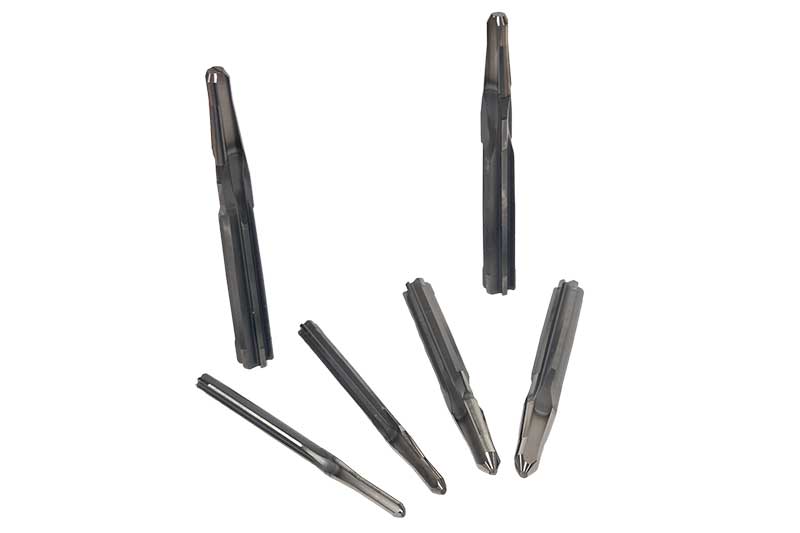
Star manufacturers a wide variety of gundrills and reamers, both stock and custom design in a wide range of sizes.

 In view of the great number of materials suitable for gundrilling as well as other variables, a table of specific grinds for all situations is not feasible.  Instead, the gundrill user must understand the function of drill geometry well enough to use available tables as a starting point and them make refinements to suite the particular setup, work material and hole specification.

The cutting edge angles of the conventional gundrill determine chip shape, size, finish, tool life, and therefore, determine tool efficiency.  Generally, softer materials require a smaller included angle.  Hard materials require a larger included angle.  No single pair of angles in best for all materials, but the 30°/20° slash angle combination will drill almost any workpiece material.  For some materials, it may not be 100% efficient, and changes in the included angles and lengths of cutting angles can improve performance.

Ordinarily, the inside angle needs a primary clearance of 10° to 15° while the primary clearance for the outside angle will vary from 12° for hard steels, to 15° for aluminum or magnesium.  In addition, the outside angle must have a form relieved secondary clearance of 15° to 25°.  The secondary clearance area for the outer angle is important because it prevents heeling and it provides controlled access for the cutting fluid to reach the cutting edge.


As a principle of conventional gundrill design, the edge forming the inside angle must extend 0.0005” to 0.032” past the center of the tool, depending on diameter.


Coolant Hole Configurations


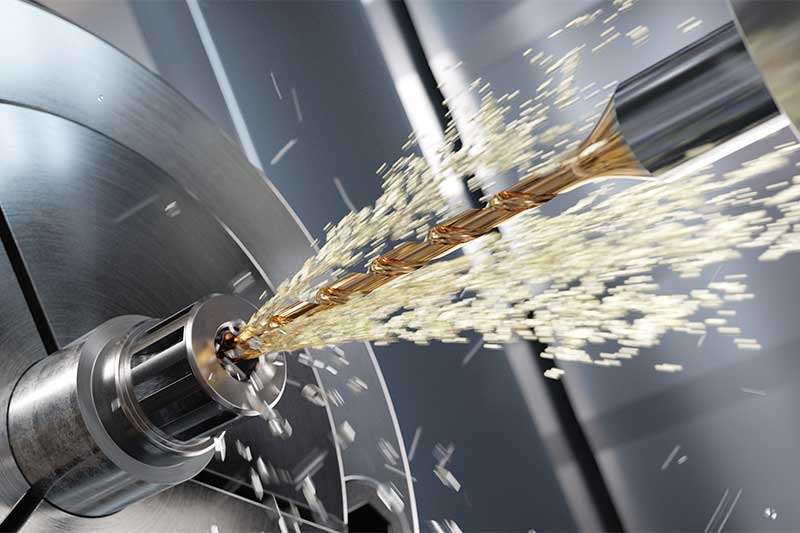
Coolant pressure and coolant hole size play an important part in gundrill performance.  The higher the penetration rates, the more important coolant pressure and flow become to evacuate chips and lubricate the cutting edge and wear margins.


Star SU provides three styles of coolant holes with the Double Jet gundrill.


Single plain round coolant holes can be provided in all gundrills.  Elongated coolant holes are standard in sizes .0787” through .3750”.  Plain round coolant holes must be specified in these areas if elongated coolant holes are not desired.


To cut steels or difficult to machine materials, a good sulfur based coolant is recommended.  Coolant temperatures should be maintained below 120° F.

Star SU gundrills are furnished in C-3 micro grain carbide and can also be furnished in C-2 carbide on request.


High Penetration Rate Gundrills


Star SU double crimp 2-flute, 2 hole gunrills improve tool performance in selected aluminum and cast iron applictions by directing more coolant to the cutting edge and allowing more room for chip ejection.  This is accomplished by making the tool with deeper flutes and larger coolant holes.

The double crimp style gundrill has the two flutes produced by a swaging process instead of the conventional method of milling heavy wall tubing.  Using thin walled tubing and swaging, the two flutes have several advantages.  First, the coolant holes in the gundrill body are formed by the crimping action, eliminating a milling operation.  Second, the coolant holes that are created have an irregular shape, and carry a much larger volume of coolant than comparable holes in an equivalent conventional gundrill body.  Also, the flutes that are formed are much deeper than conventional milled tools because allowance does not have to be made for maintaining wall thickness from flute to coolant hole.  These deeper flutes improve the chip removal efficiency of the gundrill.


Star SU enqineers note that gundrills produced by the swaging method are most advantageous in the smaller diameter gundrills where flute depth in most cases is double that of milled types.  Star SU produces the double crimp 2 flute, 2 hole gundrills in diameter sizes from 3/16” to /4”.  Milled gundrills are recommended for cast iron and die cast aluminum and certain special steel applications.


Star Reamers

Star SU Pressure Coolant Reamers


Star SU pressure coolant reamers utilize pressurized coolant to force chips ahead of the tool to produce ultra-smooth, ultra-precise holes.  They can be effectively applied in the production of precision holes to tolerance os 0.0005” and less in steel, cast iron, malleable iron, nodular iron, aluminum, bronze and exotic materials.


Ideally adapted to the sizing and enlarging of previously drilled or cored holes, Star SU reamers provide higher penetration rates and closer size tolerance.  They have a longer tool life than carbide reamers without pressurized coolant and have no tendency to follow pre-drilled or cored hole surfaces.  Thus, they can product precise, straight holes.


Star SU reamers are made in sizes from 3/16” to 4” in diameter.  Cutting speeds are the same as those recommended for multiple flute gundrills.  When drilling steel and exotic materials, speeds are from 65 to 500 sfm, with feeds from 0.001” to 0.003” per flute.  Coolant (sulfur-chlorinated oil or equivalent) pressures range from 150 psi for aluminum to 350 psi for steel.


In blind hole applications the coolant hole in the reamer is in the center of the tool tip and chips are flushed back through the flutes that extend down the body of the tool.


Star SU reamers are made in both multiple flute and multi-diameter types.  They can have solid carbide heads brazed to a tubular steel body in sizes up to 2.0” diameter and with brazed inserts in 2.0” to 4.0” diameter ranges.


Star SU PCD Reamers


When hole size finish (10 microinch or less) and tool life are critical, Star Su manufacturers a full line of fixed polycrystalline diamond pressure coolant and non-pressure coolant reamers.


Diamonds fixed into carbide or HSS bodies:

            multi-step design

            straight flute design

            spiral flute design

            various shank (holder) designs


Tools can be used with bushing for support, but the bushing must be slotted or counter bored so that the diamond does not come in contact with the bushing ID.


Tools can also be used unbushed, but hole entry normally requires slower speeds and feeds to reduce chatter.  (Depends on length of overhang vs. diameter.  Consult engineering for guidelines.)


Diamond tools can be run at the same speeds and feeds that conventional pressure coolant carbide tools are run, but the option exists for accelerated RPM’s.  Example:  aluminum, 3500 RPM, 570 SFM, 53 IPM, removing .030” total stock using water soluble coolant.


Gundrill_Montage_vert.gif


Copyright 2008 Star Cutter
23461 Industrial Park Drive, P.O. Box 376 - Farmington Hills, MI 48335, USA
Phone: 248-474-8200 - Fax: - Contact Us


Site Managed with SiteBaseTM Web Tools from NetCrafters.com